How to Clean Microwave Grease Without Damaging the Finish
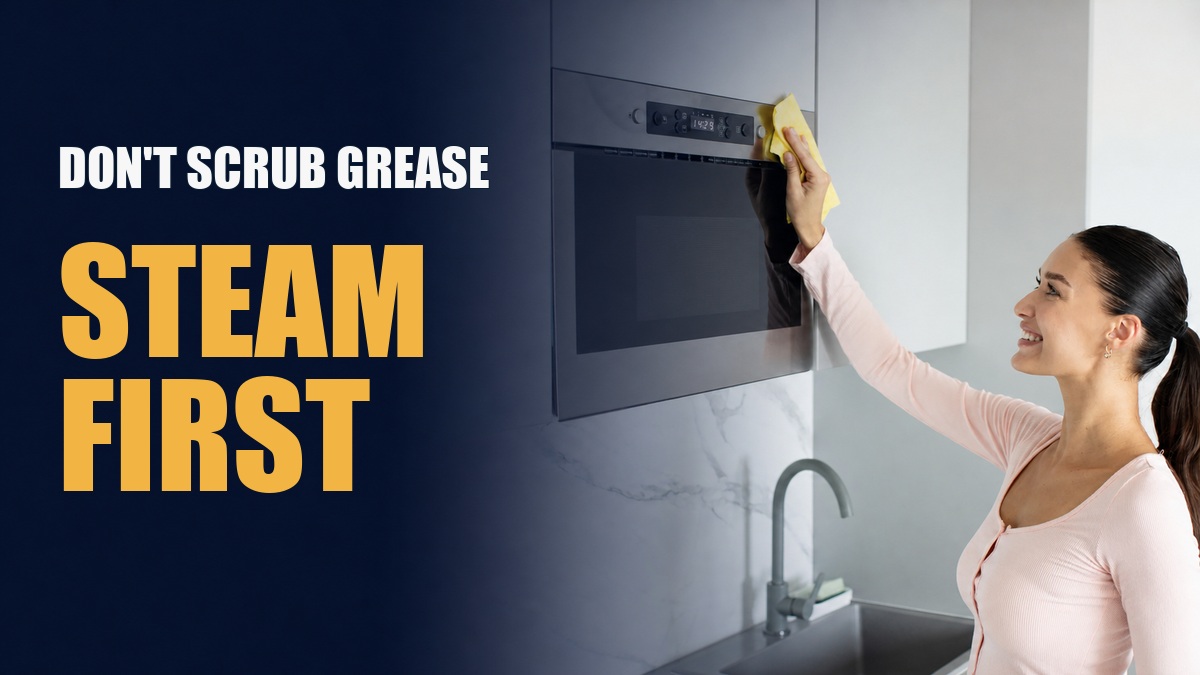
You heat up a quick bowl of soup, glance at the microwave ceiling, and stop.
A sticky film of old splatters and yellow grease is clinging above your food.
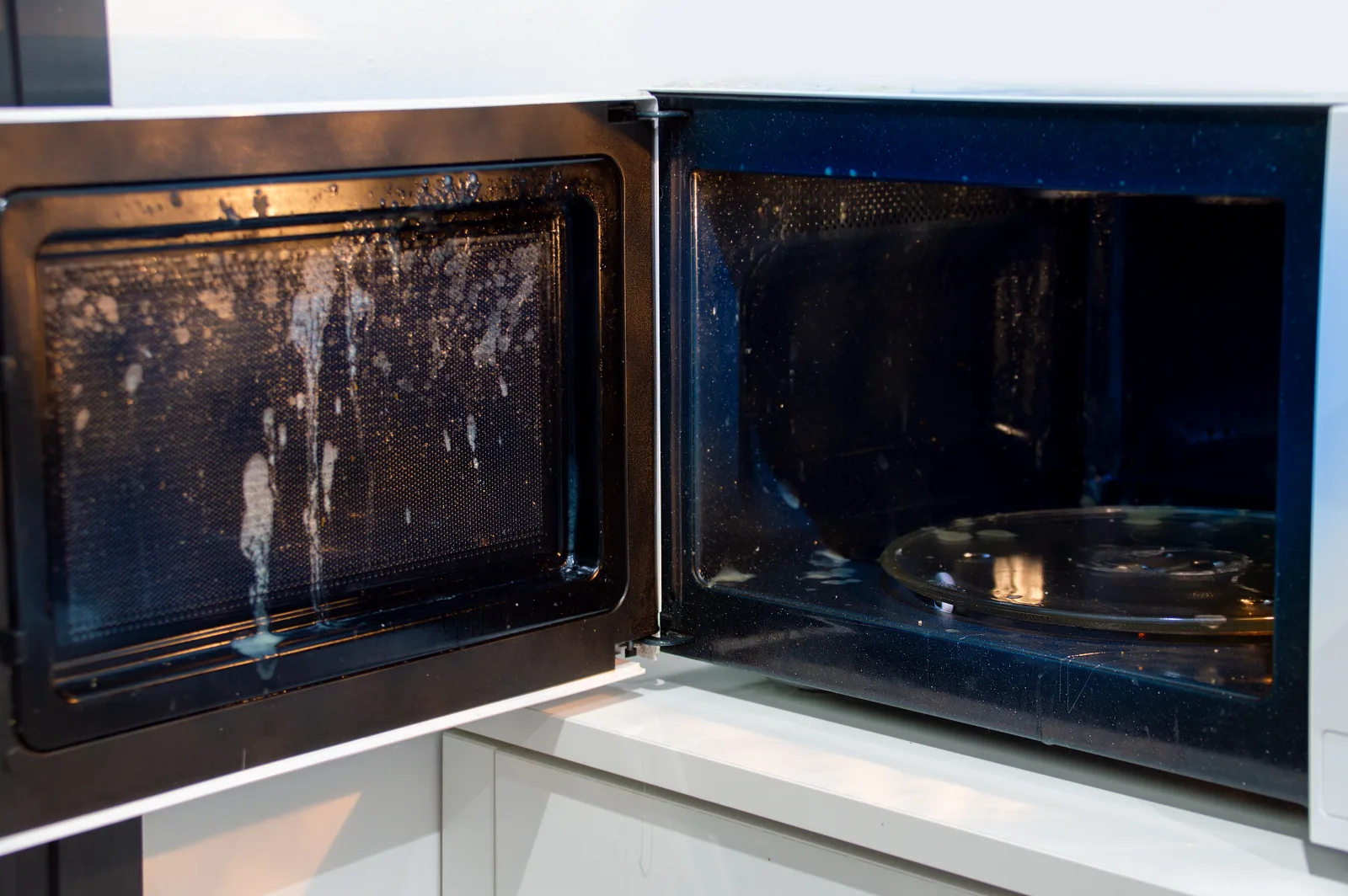
Before reaching for a harsh scrubber, pause. Steam can soften most of that baked-on mess before you touch the finish.
The safest way to clean microwave grease is to soften it with steam, then wipe with warm water and a small amount of dish soap.
Rinse away all cleaner residue and dry the interior.
Use a nonabrasive cloth and keep liquid out of vents and controls.
Follow the manual before removing filters or panels.
Steam loosens dried food and grease without the metal scraper, harsh oven cleaner, or abrasive pad that can damage the cavity coating, door mesh, or stainless finish.
Your Steam-Cleaning Kit
- Microwave-safe bowl
- Water
- Small amount of mild dish soap
- Two microfiber cloths or soft sponges
- Baking soda for a mild paste only if the manual permits
- Oven mitts
The grease may look permanent, but steam and a soft cloth should do most of the work. If the finish itself is damaged, cleaning is no longer the answer.
The Steam-First Reset: How to Clean Microwave Grease Safely
- Check the manual and cool the appliance. Unplug a countertop model if the manufacturer recommends it. For a built-in or over-the-range unit, switch it off as directed.
- Remove loose crumbs. Lift out the glass tray and support ring when removable.
- Create steam. Heat a microwave-safe bowl of water until the cavity becomes steamy, then keep the door closed for several minutes. Heating time varies by wattage; do not boil the bowl dry.
- Remove the hot bowl carefully. Use oven mitts and avoid leaning over hot steam.
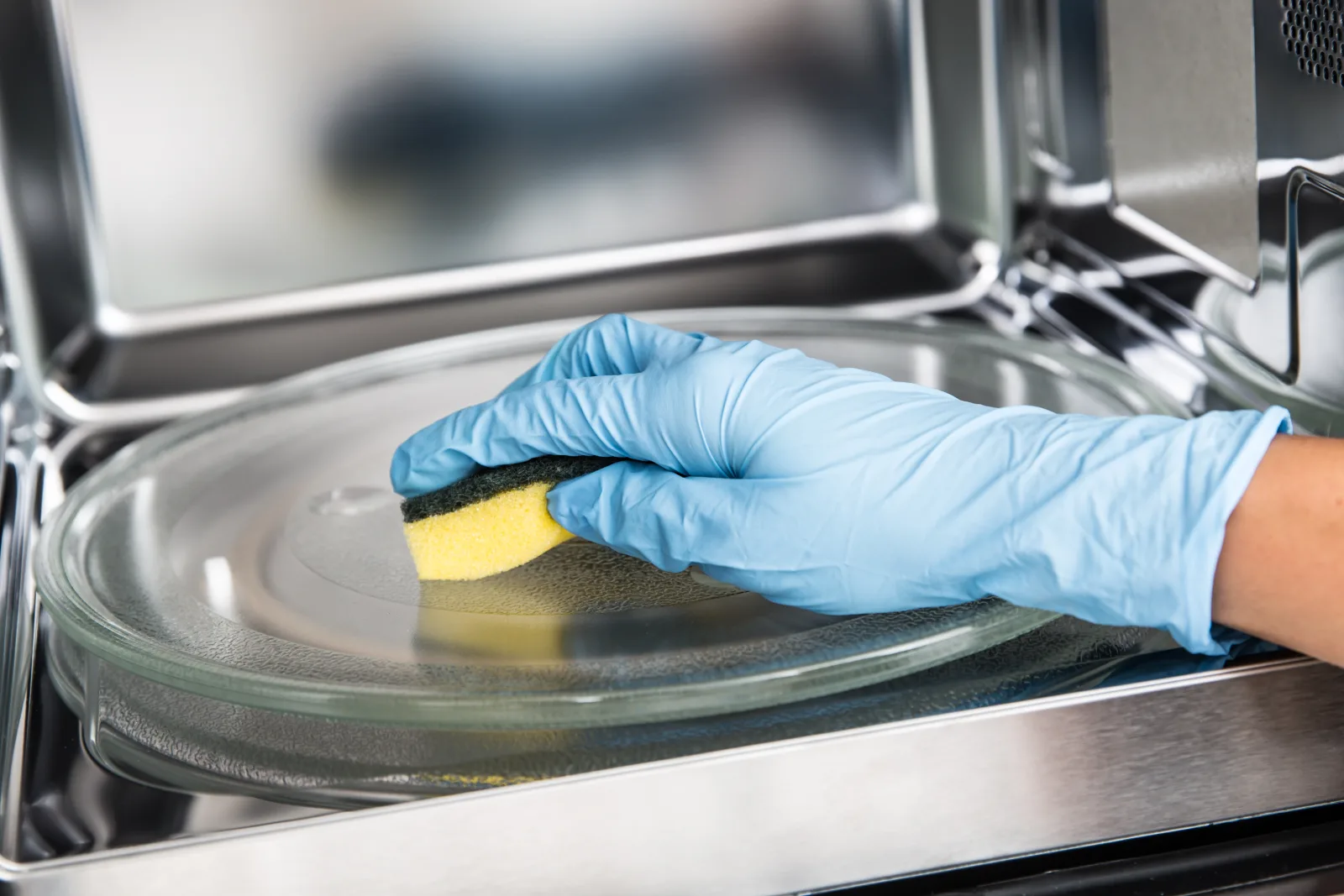
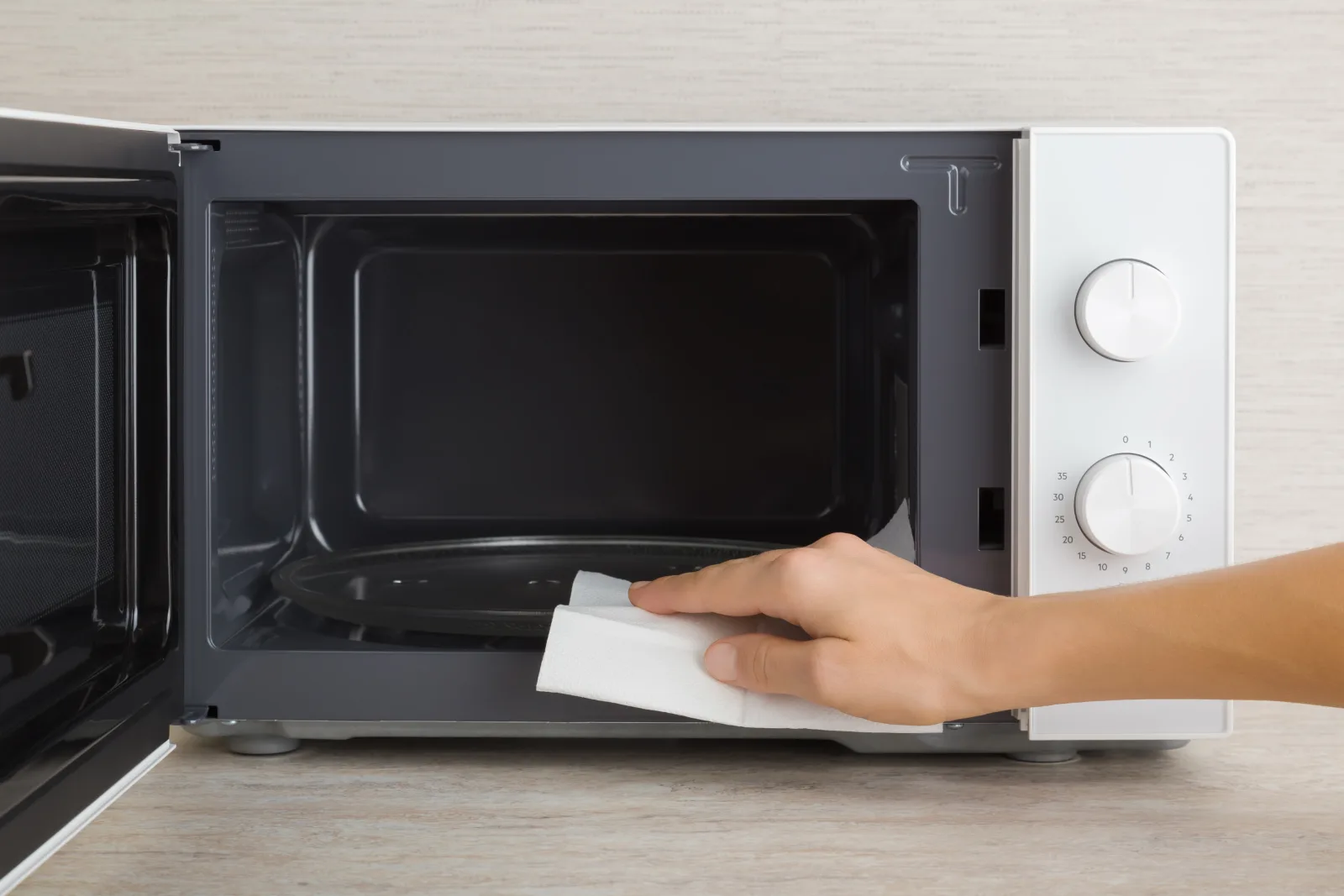
- Wipe from the ceiling down. Clean the ceiling first, then walls, floor, door, and gasket area with a soft damp cloth.
- Cut remaining grease. Add a drop of dish soap to warm water and work in small sections. Do not spray cleaner directly into vents or the control panel.
- Rinse and dry. Wipe again with a clean water-dampened cloth, then dry all surfaces before replacing the tray.
When Grease Fights Back: The Safe Second Pass
Repeat the steam step before increasing abrasion. Freshly softened grease usually releases with dish soap and several gentle passes.
For a localized stain, some manufacturers allow a paste of baking soda and water applied with a soft cloth.
Test a small area and rinse completely.
Do not scrape the cavity with a knife or razor.
If a brown area flakes, exposes metal, sparks, or looks like damaged paint rather than grease, stop using the microwave and contact the manufacturer.
Cleaning cannot restore a compromised cavity coating or waveguide cover.
Lemon vs. Vinegar: Do You Actually Need Acid?
Lemon or diluted vinegar can help with odor and some mineral film, but hot water provides most of the softening action.
Acid is not a universal requirement for grease, and it should not be used on a surface the manufacturer excludes.
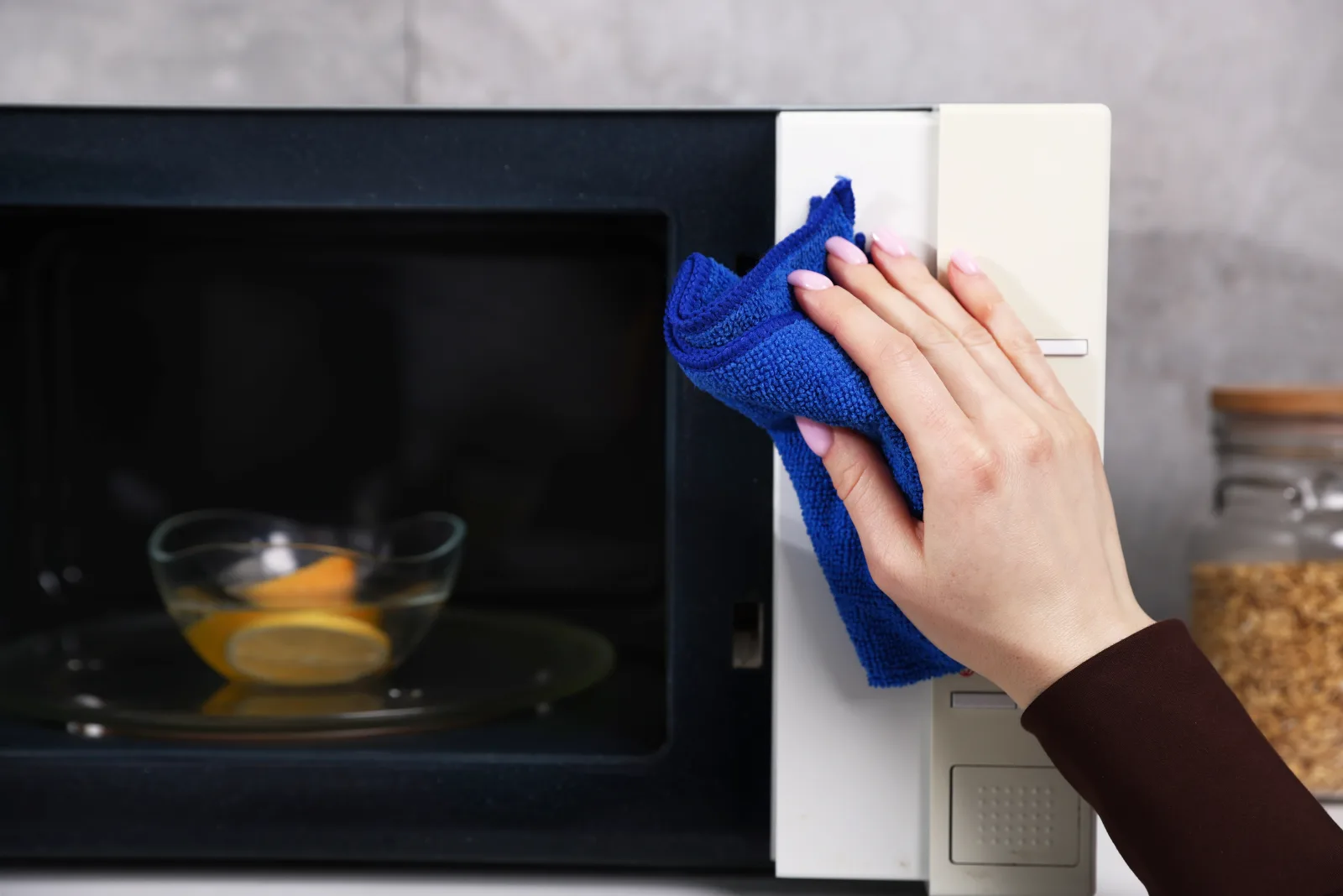
If you use lemon slices or a small amount of vinegar in the steaming water, choose a microwave-safe bowl large enough to reduce boil-over.
Monitor the cycle and wipe the cavity with clean water afterward.
Never combine vinegar with chlorine bleach.
Do not use conventional oven cleaner, abrasive powder, steel wool, or a razor inside the microwave. If the cavity coating flakes, exposes metal, or sparks, stop using it.
Outside Matters: Clean the Finish Without Electrical Damage
Apply cleaner to the cloth rather than the appliance.
Wipe the handle and control panel with a barely damp cloth, keeping moisture away from seams.
For stainless steel, follow the grain and use the cleaner recommended by the manufacturer. Black stainless and coated finishes may have different restrictions.
Grease on top of an over-the-range microwave often comes from cooking vapors.
Support yourself safely instead of standing on a counter, and do not pour liquid near the top vent.
If grease repeatedly drips from inside the cabinet, the internal air path may need professional service.
The Forgotten Filter: The Secret Grease Trap Above Your Stove
Many over-the-range microwaves have a removable grease filter underneath and a charcoal odor filter in recirculating installations.
They are not maintained the same way.
KitchenAid currently advises cleaning a washable grease filter monthly or when the filter indicator appears. Charcoal filters are generally replaced rather than washed.
- Turn off the microwave and cooktop and let both cool.
- Find the filter diagram in the exact model manual.
- Support the grease filter as you slide or release it.
- Wash it only by the approved hand-wash or dishwasher method.
- Dry it completely before reinstalling.
- Replace the charcoal filter at the specified interval; do not soak it unless the manual explicitly says it is washable.
The Low-Effort Schedule That Keeps Grease From Baking On
| Task | Frequency |
|---|---|
| Wipe a fresh spill | As soon as the microwave is cool |
| Quick interior wipe | Weekly or as needed |
| Steam deep-clean | Monthly or when grease accumulates |
| Wash removable grease filter | Monthly or per indicator/manual |
| Replace charcoal filter | According to the exact model manual |
| Inspect for arcing, peeling, or damage | Whenever cleaning |
Covering food with a vented microwave-safe cover is the easiest prevention step.
Wipe splatters while they are fresh, and grease never gets the repeated heating cycles that turn it into a stubborn film.
Editor’s Pick: Stop the Next Splatter Before It Starts
Now that the microwave is clean, the simplest way to protect the finish is to cover food before reheating.
This 10.8-inch model combines a vented tempered-glass top with collapsible silicone.
It stores flatter and lets you see the food while it heats.
It is listed as dishwasher safe, but measure your turntable and dishes first.
Use it only as directed and leave the vents open.
Lift it away from your face because trapped steam can be hot.

Frequently asked questions
What removes grease from inside a microwave?
Steam first, then warm water with a small amount of mild dish soap on a nonabrasive cloth. Rinse with a clean damp cloth and dry. Follow the model manual for approved products.
How long should I steam a microwave before cleaning?
Use the time in your manual or heat a microwave-safe bowl only until the cavity is steamy, then let it stand closed for several minutes. Wattage and bowl size change the time, so monitor it and never boil the bowl dry.
Can I use oven cleaner in a microwave?
No, unless the microwave manufacturer specifically approves that exact product, which is uncommon. Oven cleaner and abrasive products can damage coatings and leave unwanted residue.
How often should an over-the-range microwave grease filter be cleaned?
Many manufacturers recommend about monthly or when the filter indicator appears. The exact filter may be hand-washable, dishwasher-safe, or replace-only, so check the model manual.
For the rest of the kitchen reset, see how to clean a garbage disposal, how to clean a rice cooker safely, and how to organize a refrigerator shelf by shelf.
Sources
- KitchenAid microwave cleaning guide
- Whirlpool microwave filter guidance
- USDA FSIS microwave safety guidance
Guidance checked in August 2026. Cleaning products, filter types, electrical shutoff steps, and removable parts vary by model.